FlowTracker Analytics Inc. - bank customer behaviour analytics  

Flowtracker Bank Analytics


Search Web Pages


Bank deposit and loan customer, product and account acquisition

How important is deposit and loan acquisition ?

Purchases of branch networks (not in distress situations) reveal that banks may pay between 5 and 8 percent of balances to acquire retail deposit account relationships. On 10 billion of deposits this translates to 500 to 800 million dollars of acquisition cost. Loan acquisition costs of 1.5% percent are not uncommon. This translates to 150 million for every 10 billion of loans acquired.

These are large costs in relation to the net interest margin and fees yielded by these accounts, which means increasing efficiency of acquisition has a big impact on botttom line performance and the rate of capital growth in your bank.
Deposit balance growth by customer status and account status, retail bank - click to enlarge

Deposit account balance growth and where it comes from


This is the profile of a typical US bank's deposit balance growth composition by customer status (new, ongoing) and account status (new, ongoing). We have applied a "filter" to screen out small account changes arising from interest capitalization and nominal account activity.

Only 12% of growth comes from acquiring new customers. 80% comes from ongoing customers, and half of that growth occurs in accounts that already existed in the bank.

If the bank measures acquisition volume based on new customers, only 12% of the total growth is captured. If they use new accounts as their growth metric, only 52% of the total growth is accounted for.

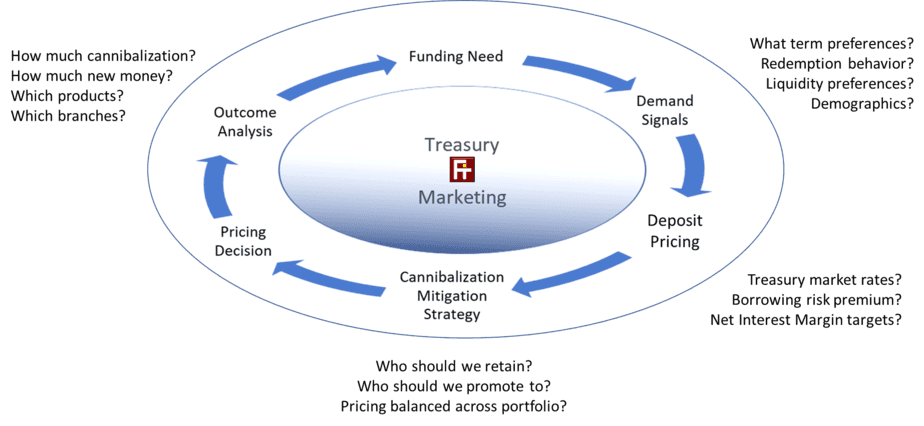
At the same time, a portion of this growth comes from product substitution and cannibalization effects. The next section takes a look at the new money growth excluding product substitution.

New money deposit acquisition excluding product cannibalization, US Retail bank - click to enlarge

New money deposit growth (funds sourced outside the bank)


In this chart we are seeing the growth in the bank's deposit portfolio looking at new money only (excluding product and account substitution and cannibalization).

Growth from new customers amounts to 16% of total new money. New accounts (including new customers) account for only 44% of the total, and an equal amount of new money growth appears in ongoing accounts of ongoing customers.

Clearly if you want to measure acquisition programme success in a bank, it is imperative to include new money growth from all sources - new accounts, new customers and ongoing accounts and customers.

FlowTracker is the only method available today that enables you to track these flows.

Funding sources of deposit account growth :: retail bank - click to enlarge

Why the differences ?


The difference between new money growth and total growth in the bank's balances is the result of three phenomenon:

  • Customers move money between accounts of the same product, for example, renewing a term deposit or loan (account switch)
  • Customers move money among products, shifting deposits or loans into different types of accounts. This is product substitution and product cannibalization (product switches).
  • Customers move money from deposits to loans paying down debt, and from loans to deposits when they borrow to invest (transfers).

FlowTracker identifies and quantifies each of these flows for every customer for every account in every location within your portfolio.

Sales | Acquisition | Cross-sales Demo video

See a short video describing how FlowTracker compares to customer, product and account based sales metrics.

You may also wsish to see this video showing how FlowTracker can help you focus on increasing the accuracy of acquisition predictive analytic models.

 Printable Version

 Subscribe to FTAI    Subscribe to Customer Analytics | Business Intelligence | Management    Subscribe to Customer Behaviour Analytics

Banking Customer Analytics | Banking Customer Intelligence | Banking Business Intelligence | Banking Product Analytics
Copyright © 2007 - 2010 FlowTracker Analytics Inc. All rights reserved